
Nikkei Stock Average Plunges for Consecutive Days, Down 5,000 Yen

Daily Market Analysis
Expert analysis of today's market movements and trading opportunities
Daily Market Analysis
Expert analysis of today's market movements and trading opportunities
Fundamental Analysis
- The Nikkei 225 has fallen sharply for consecutive days due to surging oil prices, a weaker yen, and rising geopolitical risks. The index has already broken below the 52-day moving average, suggesting that the previous uptrend may have ended. If tensions in the Middle East continue to escalate, the market could face further downside, potentially dropping below 50,000. With RSI falling below 50, bearish sentiment is increasing, and short-term traders may look for opportunities to sell on rebounds.
Nikkei Breaks Down
Let us examine the daily chart of the Nikkei Stock Average. The index had been approaching the 60,000 level but has now collapsed sharply. Several factors have worsened investor sentiment, including a surge in crude oil prices, the weakening yen, and rising geopolitical risks and uncertainty.
The index has already fallen below the 52-day moving average, indicating that the previous uptrend has been broken. Compared with the situation when the Russia-Ukraine conflict began, the current environment appears more serious. The Middle East situation is no longer limited to a confrontation between the U.S., Israel, and Iran. It is developing into a broader conflict that could involve the United Kingdom, France, and surrounding Middle Eastern countries. Although President Trump previously suggested the issue could be resolved within four weeks, it now appears unlikely to be settled within a month.
Unless the situation changes quickly, the Nikkei may fall below the 50,000 level. It is also notable that the RSI has dropped below 50. If RSI falls below 45, selling pressure through short positions could become stronger than buying on dips.
The key point to watch will be whether the 52-day moving average now acts as resistance.
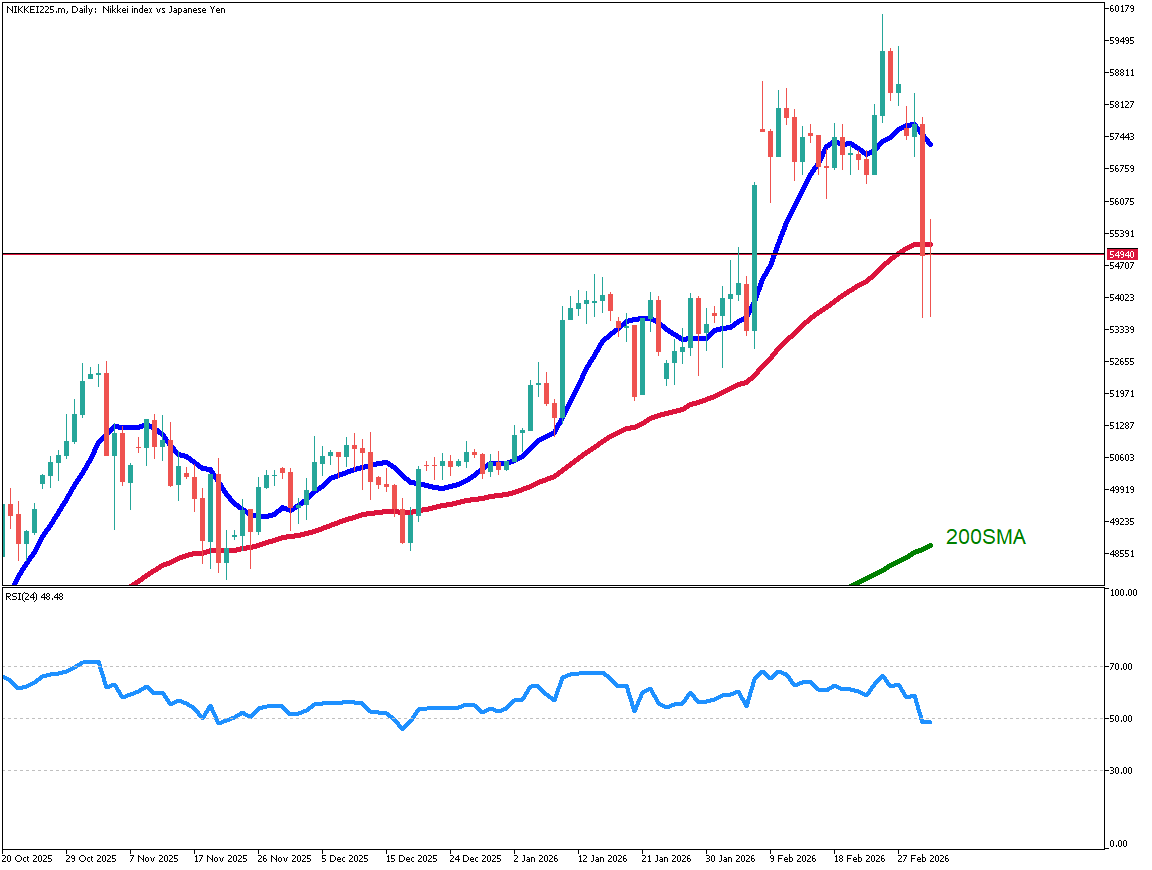
NIKKEI225 / Daily Chart
Temporary decline or the beginning of a downtrend?
Geopolitical risks are gradually escalating. If the conflict expands to involve Europe, the United States, Israel, and Middle Eastern countries, the impact on stock markets could be significant. In particular, surging energy prices would put pressure on corporate profits.
Looking at the 1-hour chart, the price appears to be forming a double bottom. However, for short-term trading, selling on rebounds may be the preferable strategy. If the price rebounds toward the 50% Fibonacci retracement level, it may present an opportunity to enter short positions.
If U.S. stocks experience a sharp decline, the Nikkei could also fall rapidly in response. Therefore, it may be prudent to wait until the market stabilizes before taking major positions.
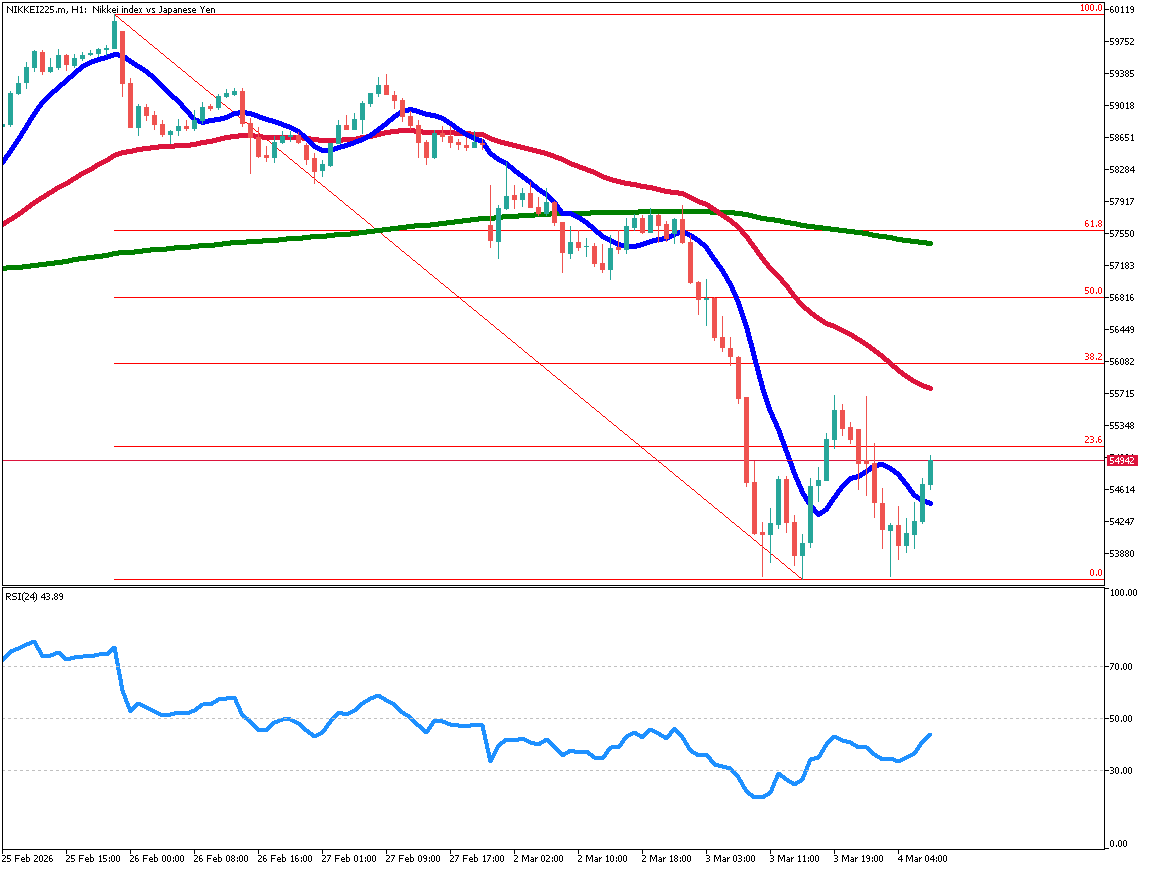
NIKKEI225 / 1-Hour Chart
Ready to trade?
Open live accountRelated Analysis
This material is for informational purposes only and does not constitute investment advice. Trading leveraged products involves significant risk of loss. Past performance is not indicative of future results.